Perdition meaning: the state of eternal damnation, or hell itself. Long ago, it also meant complete ruin.
It is a small word with a scary reputation. Below, you will learn what it means, where it began, which words match it, and how to use it in a sentence.
Table of Contents
What Is the Meaning of Perdition?
Perdition points to one idea: a loss that cannot be undone. The setting changes, but the weight stays the same.
What does perdition mean? It means the damnation of the soul after death. It also names hell, the place of eternal punishment. It is a noun, and you say it per-DISH-un.
The word works in three ways:
- Religious: the loss of the soul, or the abode of Satan where sinners suffer.
- Archaic: utter destruction, or plain loss. You will mostly see this in old books.
- Figurative: a hopeless mess, a ruin, or a painful downfall.
Is perdition in the Bible? Yes. The King James Bible uses it in several places, including 1 Timothy 6:9 and 2 Peter 3:7. In each case, it points to final ruin.
Who is the “son of perdition”? The title appears only twice in the New Testament. John 17:12 applies it to Judas Iscariot. 2 Thessalonians 2:3 applies it to the “man of sin.” Scholars read the phrase as “one doomed to destruction.” Latter-day Saint teaching also uses “sons of perdition,” for people who fully reject God after knowing the truth.
Tone matters here. Perdition is a formal, literary, and dramatic word. It suits sermons, poems, and stories. In casual talk, people use it as playful exaggeration.
Must Visit: Touche Meaning: The Surprising Definition, Origin & How to Use It
Perdition Origin and Word History
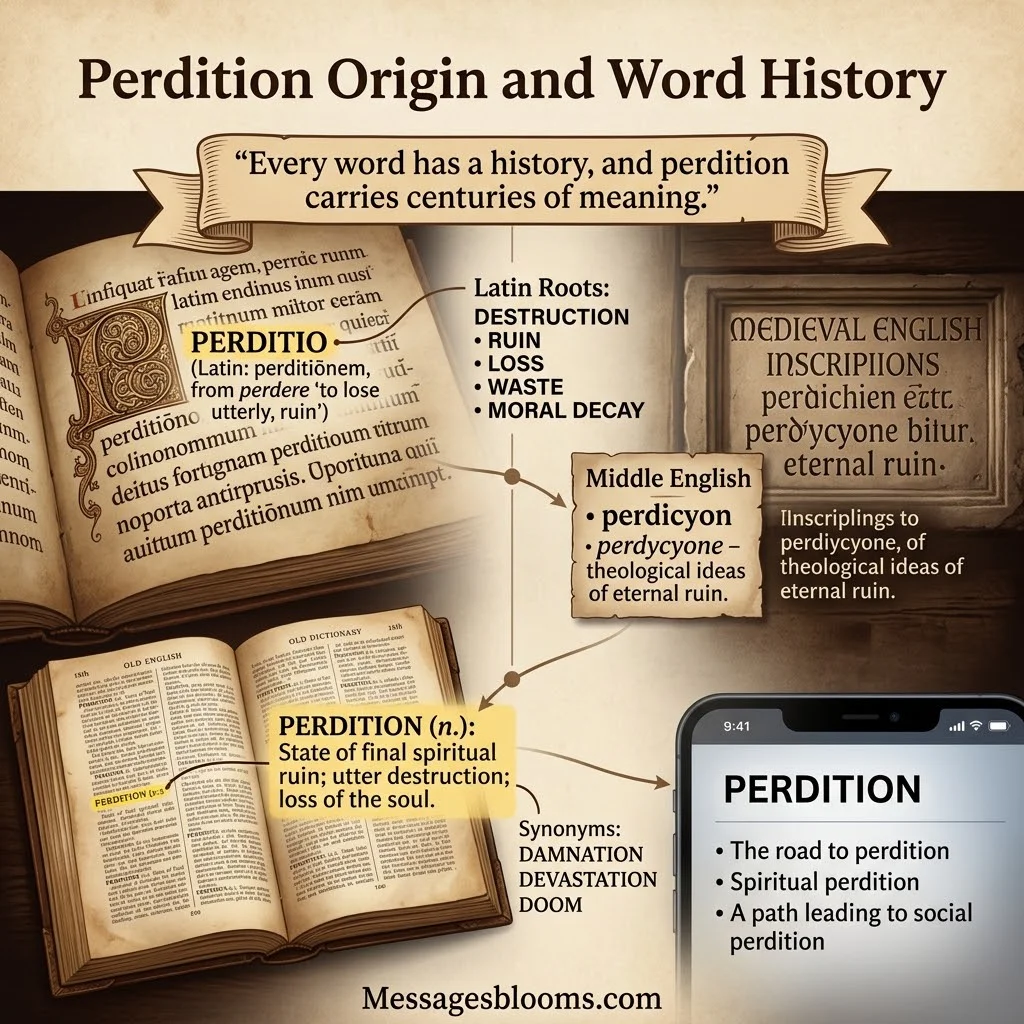
The word’s past is a story of giving things away. Its etymology runs from ancient Rome to modern English.
The Latin verb perdere means “to destroy” or “to lose.” It joins per- (“thoroughly”) and dare (“to give”). Think of giving something away until nothing remains.
The word then traveled through four stages:
- Latin: perdere
- Late Latin: perditio
- Anglo-French: perdiciun
- Middle English: perdicion, first used in the 14th century
That is more than 600 years of use. The date is no accident. Dante was writing his Inferno in that same era, and fear of hell shaped much of medieval writing.
Did perdition always mean hell? No. Shakespeare used it in different ways. In Othello, the hero cries, “Perdition catch my soul, but I do love thee.” That is damnation used as a vow of love. Elsewhere in the play, the word describes the wreck of a fleet.
In The Tempest, Prospero says not a hair on any passenger was harmed. He uses “perdition” to mean simple loss. Here the word carries no fire at all.
Later, John Milton wrote of “bottomless perdition” in Paradise Lost in 1667. Over the centuries, the religious sense grew strong and pushed the older senses aside. Today, it almost always means damnation.
Perdition Synonyms and Related Words
Perdition has many relatives. Each one has a slightly different shade, so choose with care.
What are synonyms for perdition? The most common are hell, inferno, hellfire, damnation, doom, ruin, downfall, and destruction. Older or rarer options include Gehenna, Tartarus, Hades, the pit, and the nether region.
What is the opposite of perdition? The main antonyms are salvation, redemption, deliverance, heaven, and paradise.
How does perdition differ from hell, damnation, and purgatory?
| Word | Simple meaning |
|---|---|
| Perdition | The state of eternal ruin, or hell itself |
| Hell | The place of punishment |
| Damnation | The judgment or sentence |
| Purgatory | A temporary place of cleansing in Catholic belief |
Which word should you pick? Use hell for the place. Use damnation for the sentence. Use perdition when you want a formal, weighty tone. Use ruin or downfall when no religion is involved.
Several phrases are worth knowing:
- Path to perdition: a road that leads to ruin.
- Fires of perdition: the flames of hell.
- Consigned to perdition: sent to a final, hopeless fate.
Must Visit: AFK Meaning: Discover the Exact Meaning, Origin & Best Examples
Perdition Examples in a Sentence
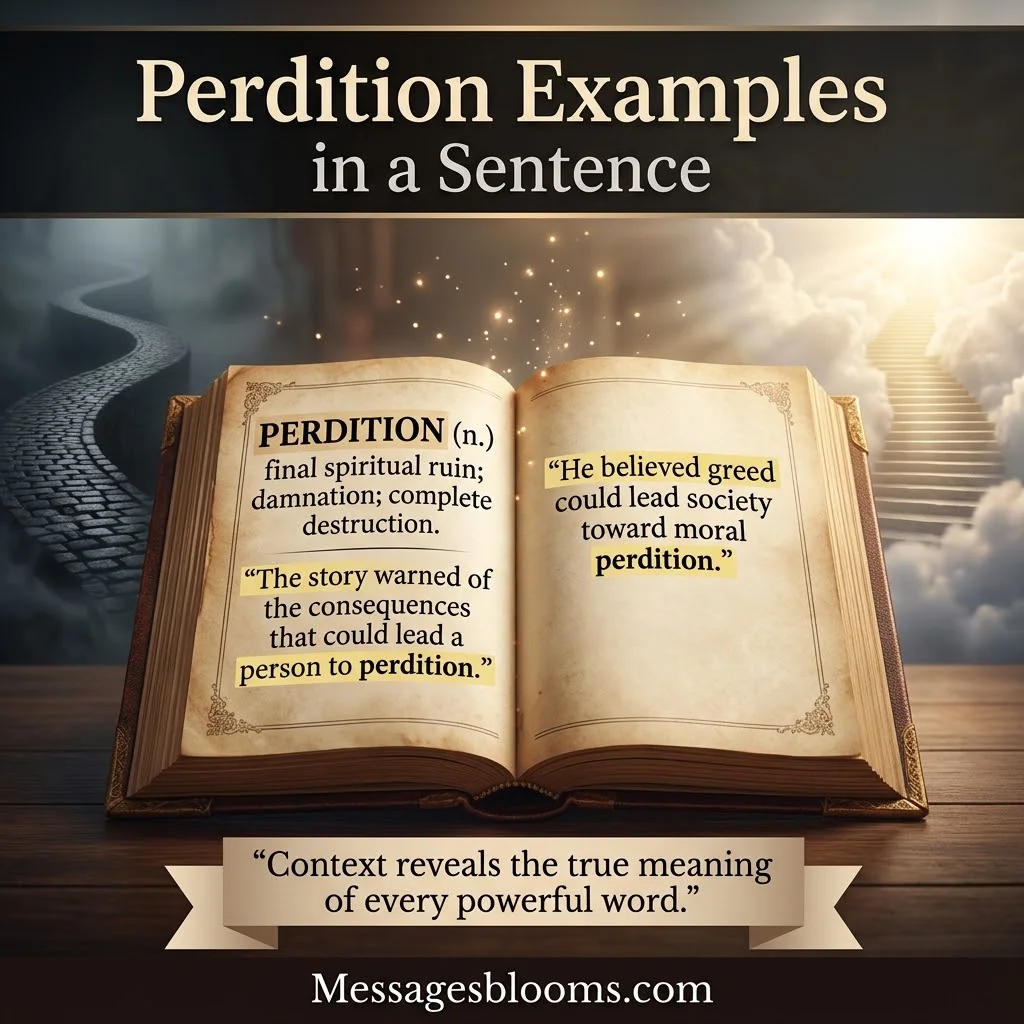
Good examples show a word at work. Try these in your own writing.
Serious and religious:
- The priest warned that pride could lead a soul to perdition.
- In the old poem, the rebel angels fall into perdition.
Everyday and figurative:
- The bill sat in a committee and was buried to perdition.
- A dead phone, a missed train, and a rainstorm made the morning feel like perdition.
- He knew that one more lie would put him on the path to perdition.
Is perdition still used today? Yes. Reporters and columnists use it for bills stuck in committee. Writers also use it for slippery slopes, such as laziness leading to bigger trouble. It appears less in daily chat, but it still lands with force.
In books and film:
- Mary Shelley used the word in Frankenstein to show a doomed creation.
- The 2002 film Road to Perdition stars Tom Hanks as a hitman on a deadly road. It is based on a graphic novel, and it won an Academy Award for cinematography.
Words people confuse with perdition:
- Predilection: a strong liking for something.
- Prediction: a forecast about the future.
- Perdition: damnation or complete ruin.
FAQs
What does perdition mean in simple words?
It means eternal damnation or hell. It can also mean complete ruin or loss.
What is the biblical meaning of perdition?
In the Bible, it means final destruction and the loss of the soul. The phrase “son of perdition” appears in John 17:12 and 2 Thessalonians 2:3.
What is the origin of the word perdition?
It comes from the Latin perdere, meaning “to destroy” or “to lose.” It entered English in the 14th century.
What is the difference between perdition and hell?
Hell is the place of punishment. Perdition is the state of ruin, and it can also name that place.
What does “path to perdition” mean?
It means a route that ends in ruin. People use it for bad choices and serious warnings.
Conclusion
Perdition means eternal damnation, hell, and, in older use, utter destruction. It began in Latin, grew in medieval Europe, and gained power through Shakespeare and Milton. Use it when a moment calls for weight, and it will do its job.

Sohail John is a creative SEO content writer who crafts engaging, humorous, and audience-focused digital content. He specializes in writing viral blog posts, catchy headlines, and social media captions that attract readers and improve search engine performance. His writing style combines clarity, creativity, and entertainment to deliver high-quality content that boosts engagement and builds strong online presence for websites and brands.