Someone fires off a sharp comeback. You have no reply, so you say “touché.” But do you know what the word really means?
The touche meaning is simple: it admits the other person made a good point. The story behind it is not. It starts on a fencing strip in France.
Table of Contents
What Does Touche Mean? Definition & Pronunciation
Here is the quick answer, plus how to say and spell it.
What does touche mean?Touché is an interjection. You say it to concede a point after someone makes a clever, fair, or witty remark. It works like saying, “You got me.” Dictionary.com lists two senses: a hit in fencing and an acknowledgment of a telling remark or rejoinder.
How do you pronounce touche? Say too-SHAY. The IPA spelling is /tuːˈʃeɪ/. The accent mark tells you the word has two syllables. As Grammarist explains, it is “too-shay,” not “toosh.”
Is “touche” spelled with an accent? Yes. The correct form is touché. Texters often drop the accent because it is hard to type. Both versions are understood, but the accented one is the dictionary spelling. Common misspellings include “touchee” and “tushay.”
The word began as a sports call. Then it moved into everyday talk.
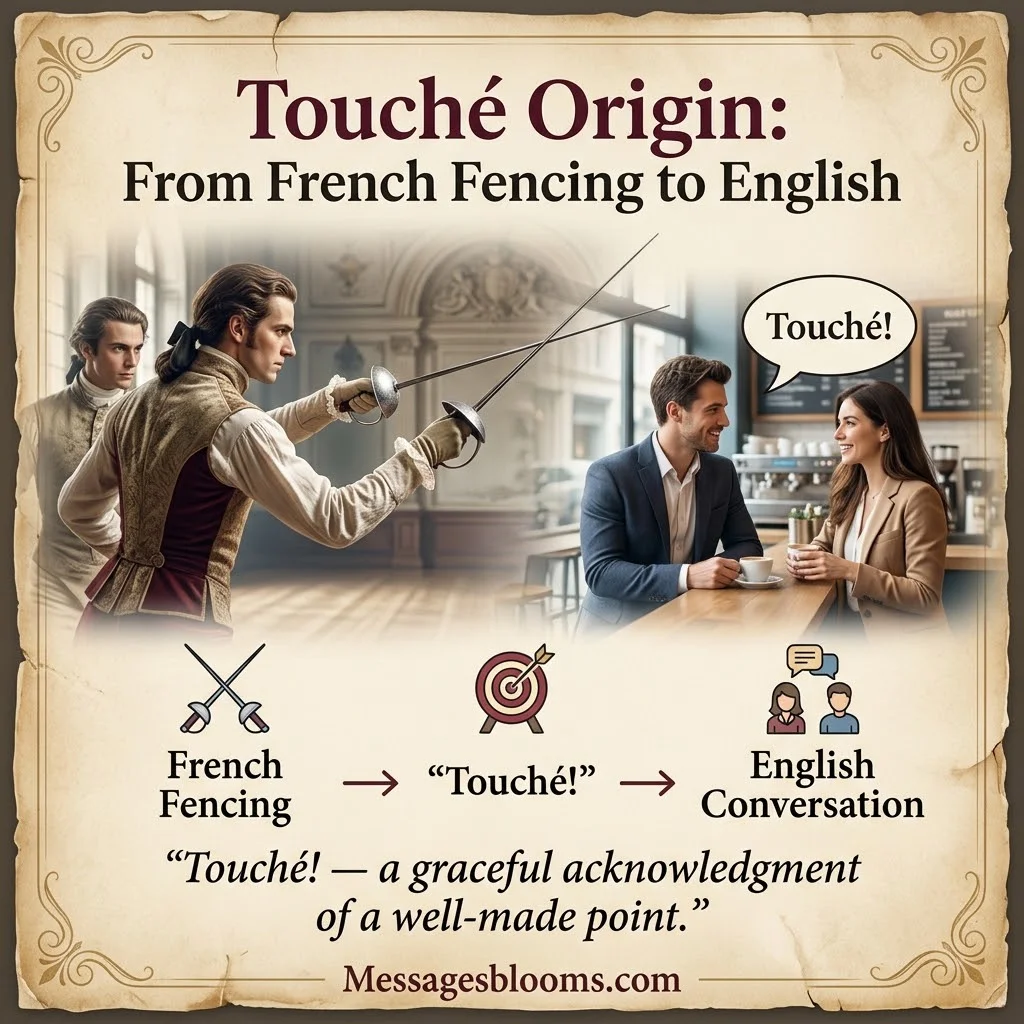
Where does touche come from? It is the past participle of the French verb toucher, “to touch.” The American Heritage Dictionary traces it to Old French touchier. The literal meaning is “touched” or “hit.”
In fencing, a fencer says touché to admit an opponent landed a scoring hit. It is a sign of sportsmanship. The sport grew fast after the first modern Olympics in 1896, according to the Australian Writers’ Centre.
When did touche enter English? Sources disagree, and that is a useful fact to know:
Source
Earliest use
Australian Writers’ Centre
1897
Wordsmith.org
1904
Dictionary.com
1920–25
The range is 1897 to the 1920s. The shift from fencing term to figurative use was slow. People began using it for words, not swords.
Touche Meaning in French vs. English
English speakers use touché far more often than the French do. In French, the word is wider and more ordinary.
Is touche a French word? Yes. It comes straight from French. English kept the spelling and the sound, but changed the job. In English, it is a witty concession. In French, touche is a noun with many uses.
What does touche mean in French?Touche is usually a feminine noun, said /tuʃ/. According to the French academy entry on CNRTL, it can mean:
A hit or point in fencing
A key on a piano or keyboard
A brushstroke in painting
The sideline in football or rugby
A small touch of something, like une touche de citron (a hint of lemon)
The verb toucher also means “to move emotionally.” Ça me touche means “that moves me.” Ne touchez pas means “don’t touch.”
English
French
Main use
Witty concession
Noun, verb, and sports term
Tone
Playful or dry
Mostly literal
Common reply
Touché
Bien vu, tu marques un point, c’est pas faux
How to Use Touche: Examples, Texting Meaning & Synonyms
The trick is timing. Say it right after the point lands, not before.
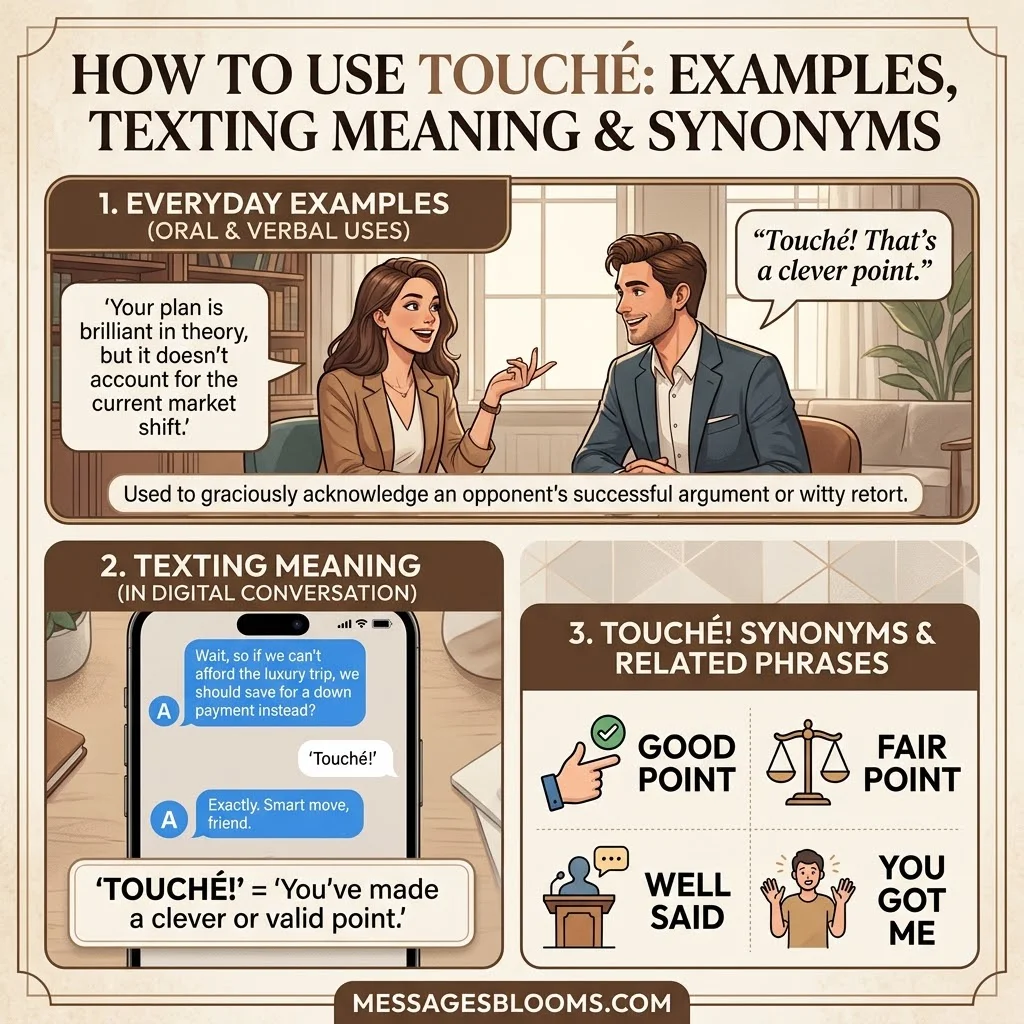
How do you use touche in a sentence? Use it as a short, standalone reply.
“You say you hate mornings, yet you run at 5 a.m.” “Touché.”
“Touché. I didn’t think of that.”
“You’re late again.” “Touché. Guilty as charged.”
What does touche mean in texting? In a group chat, it usually means light agreement or playful defeat. Tone changes everything. “Touché 😂” sounds friendly. A bare “touché.” can read as dry or sarcastic. It can also come across as clipped after a pointed remark.
When does touche sound wrong? Skip it in these cases:
After a plain fact with no wit
When someone shares a real problem or hurt feelings
When you use it again and again, which wears out its punch
What can you say instead of touche? Match the word to the setting.
Synonym
Best for
Fair point
Work and formal talk
Point taken
Work and calm debate
Good catch
Spotting a mistake
You got me
Casual chats and texts
Well played
Playful banter
Related terms include riposte, rejoinder, comeback, and witty remark. A riposte is the quick reply. Touché is what you say when that reply lands.
FAQs
What does touche mean?
Touché means “you made a good point.” People say it to admit a clever remark or fair argument. It began as a fencing call for a hit. Today it works as a friendly, often humorous way to concede a point without giving up the whole debate.
What is the exact meaning of touche?
The exact meaning is “touched,” from the French verb toucher. In fencing, it admits a valid hit. In everyday speech, it admits a valid point. Dictionaries such as Dictionary.com list both senses.
What does touche mean in English?
In English, touché is an interjection that acknowledges a sharp or witty remark. It shows respect for the other person’s logic or humor. You can use it in casual chats, texts, and friendly debates.
Is touche a French word?
Yes. Touché is French. It is the past participle of toucher, “to touch.” English borrowed it from the fencing world and kept the French spelling and accent.
What does touche mean in French?
In French, touche is a noun. It can mean a fencing hit, a keyboard key, a brushstroke, or a sideline in sports. Touché is the verb form, meaning “touched” or “hit.” French speakers also use it in playful banter.
Conclusion
The touche meaning is easy to remember: it says “you got me,” with a bit of style. It began with a fencing hit and grew into one of English’s most useful comebacks. Use it at the right moment, and it works well.
Sohail John is a creative SEO content writer who crafts engaging, humorous, and audience-focused digital content. He specializes in writing viral blog posts, catchy headlines, and social media captions that attract readers and improve search engine performance. His writing style combines clarity, creativity, and entertainment to deliver high-quality content that boosts engagement and builds strong online presence for websites and brands.