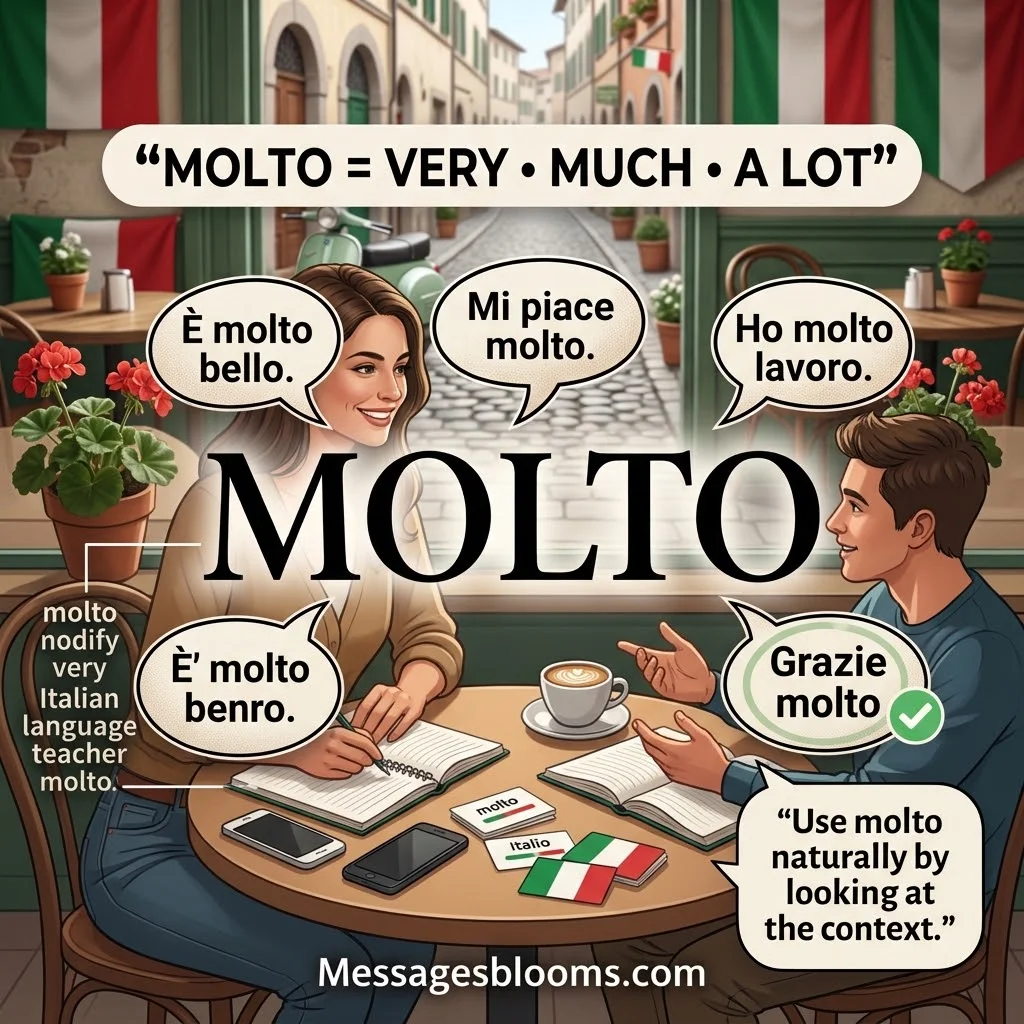
Molto meaning is simple: it is an Italian word for “very,” “much,” or “a lot.” You will see it in daily Italian and on sheet music.
This guide gives you the molto definition, the molto translation in English, how to say it, and how to use it with ease.
Table of Contents
What Does Molto Meaning in English and Italian?
If you ask what does molto mean, the short answer is “very” or “a lot.” It shows a high degree or a large amount.
Molto translation in English: very, much, a lot, a great deal
Part of speech:adverb of degree (it can also work as an adjective)
Pronunciation: MOHL-toh, with stress on the first syllable
Opposite:poco (little, not much)
Close synonyms:tanto (so much), assai (quite, very)
The word comes from the Latin multum, which means “much.” It is a cousin of English words like multiple, multiply, and multicultural. Dictionaries trace its first known use in English to the late 1700s.
It is also a very common word. It sits among the top 25 most-used Italian words and is taught at the beginner (A1) level.
How to Use Molto in a Sentence
The meaning of molto in Italian stays the same, but its form can change. It depends on the word that follows.
Use it before an adjective or adverb. Here it never changes.
Sono molto stanco oggi. I’m very tired today.
È molto bello. It is very beautiful.
Parli molto bene. You speak very well.
Use it after a verb to mean “a lot.”
Mi piace molto. I like it a lot.
Lavoro molto. I work a lot.
Use it before a noun to mean “a lot of” or “many.” Now it acts like an adjective, so it must match the noun in gender and number.
molto traffico (masculine, singular): a lot of traffic
molta acqua (feminine, singular): a lot of water
molti amici (masculine, plural): many friends
molte case (feminine, plural): many houses
Here is a real example: C’è molto traffico in centro. This means “There’s a lot of traffic downtown.”
How is molto different from tanto and troppo?Molto means very or a lot. Tanto means so much. Troppo means too much. Compare molto caldo (very hot), tanto caldo (so hot), and troppo caldo (too hot).
Can you say molto bellissimo? No. The ending -issimo already means “very.” So pick one: molto bello or bellissimo.
Common mistakes for English speakers:
Using molto with the wrong form before a noun
Saying molto twice for emphasis
Forgetting that molto before an adjective never changes
English speakers also borrow the word for fun. Fashion writers have called a bold style “molto Italiano.” In English it works as a playful way to say “very.”
While learning Italian words like “molto” can enrich your vocabulary, modern conversations often rely on quick texting abbreviations. If you’ve seen WYF in a text message, understanding its meaning can help you keep up with casual online conversations.
Molto Meaning in Music
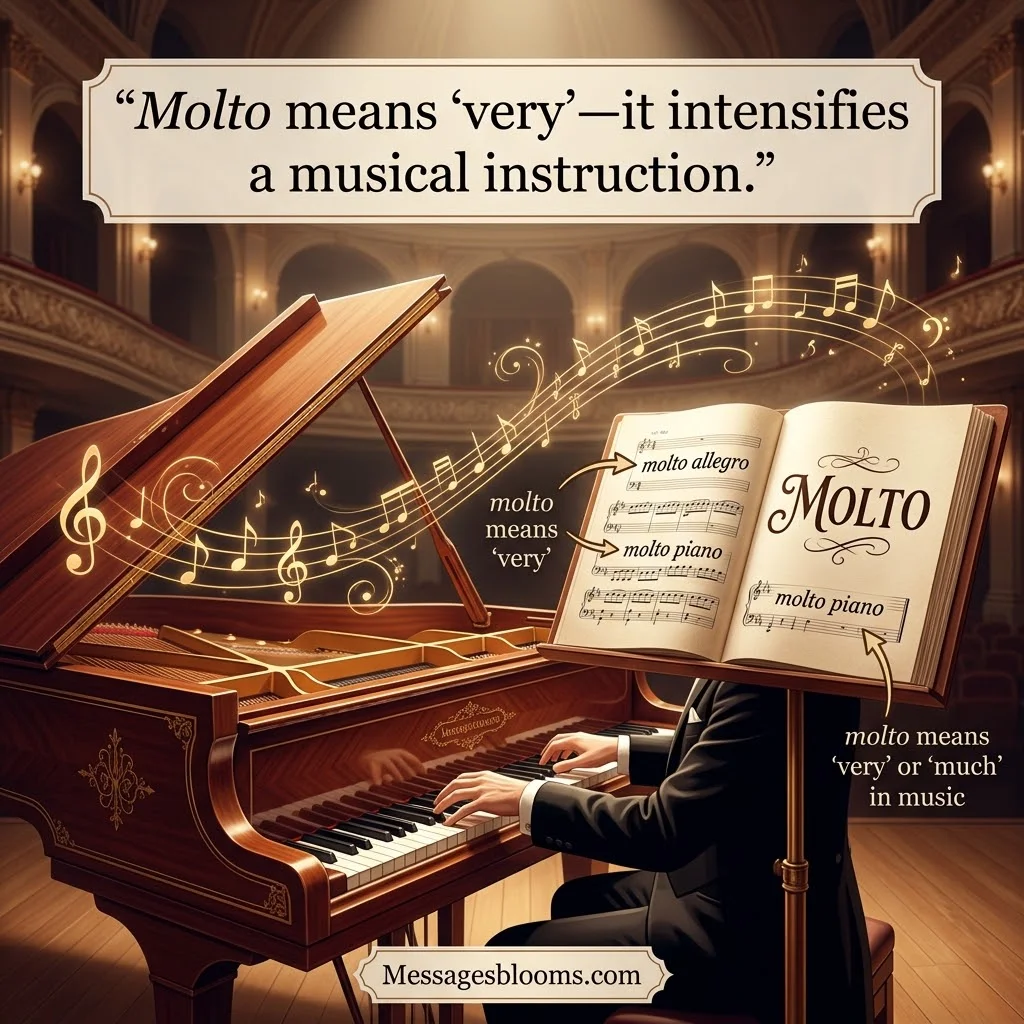
In music, molto is a direction that means “very” or “much.” It is a musical term from Italian, the language of most tempo markings and expression marks.
Here is the key point. Moltonever stands alone. It always pairs with another word, and that word tells the player what to play “very.”
Common molto music terms:
molto allegro: very fast and lively
molto adagio: very slow and calm
molto espressivo: with much feeling
molto agitato: very restless and tense
molto più animato: much more lively
The order can flip. Allegro molto and molto allegro mean the same thing.
A good way to remember it: molto turns up the volume on a direction. If adagio means slow, molto adagio means very slow.
Crossword fans know it well. A common clue is “Very, in music,” and the answer is MOLTO. The word is also valid in Scrabble and Words With Friends.
FAQs
What does molto mean in English?
Molto means “very,” “much,” or “a lot” in English. It shows a high degree or a large amount. For example, molto bene means “very well,” and molto traffico means “a lot of traffic.”
What is the meaning of molto in Italian?
In Italian, molto is an adverb that shows degree or amount. It can also be an adjective that means “a lot of” or “many.” As an adjective, it changes form: molto, molta, molti, molte.
Does molto mean very in Italian?
Yes, when it comes before an adjective or adverb, molto means “very.” For example, molto bello means “very beautiful.” Before a noun, it means “a lot of” or “many,” as in molti amici.
What does molto mean in music?
In music, molto means “very” or “much.” It pairs with a tempo or mood word. For example, molto allegro means very fast, and molto espressivo means with much feeling.
How do you pronounce molto?
Say it as “MOHL-toh.” Stress the first syllable and keep both o sounds clean and short. The IPA spelling is /ˈmolto/.
Conclusion
Moltomeans “very,” “much,” or “a lot.” Use it before adjectives and verbs in daily Italian, and match it to the noun when it means “a lot of.” In music, pair it with another term to boost its force. Start with one phrase, like molto bene, and use it today.
Sohail John is a creative SEO content writer who crafts engaging, humorous, and audience-focused digital content. He specializes in writing viral blog posts, catchy headlines, and social media captions that attract readers and improve search engine performance. His writing style combines clarity, creativity, and entertainment to deliver high-quality content that boosts engagement and builds strong online presence for websites and brands.