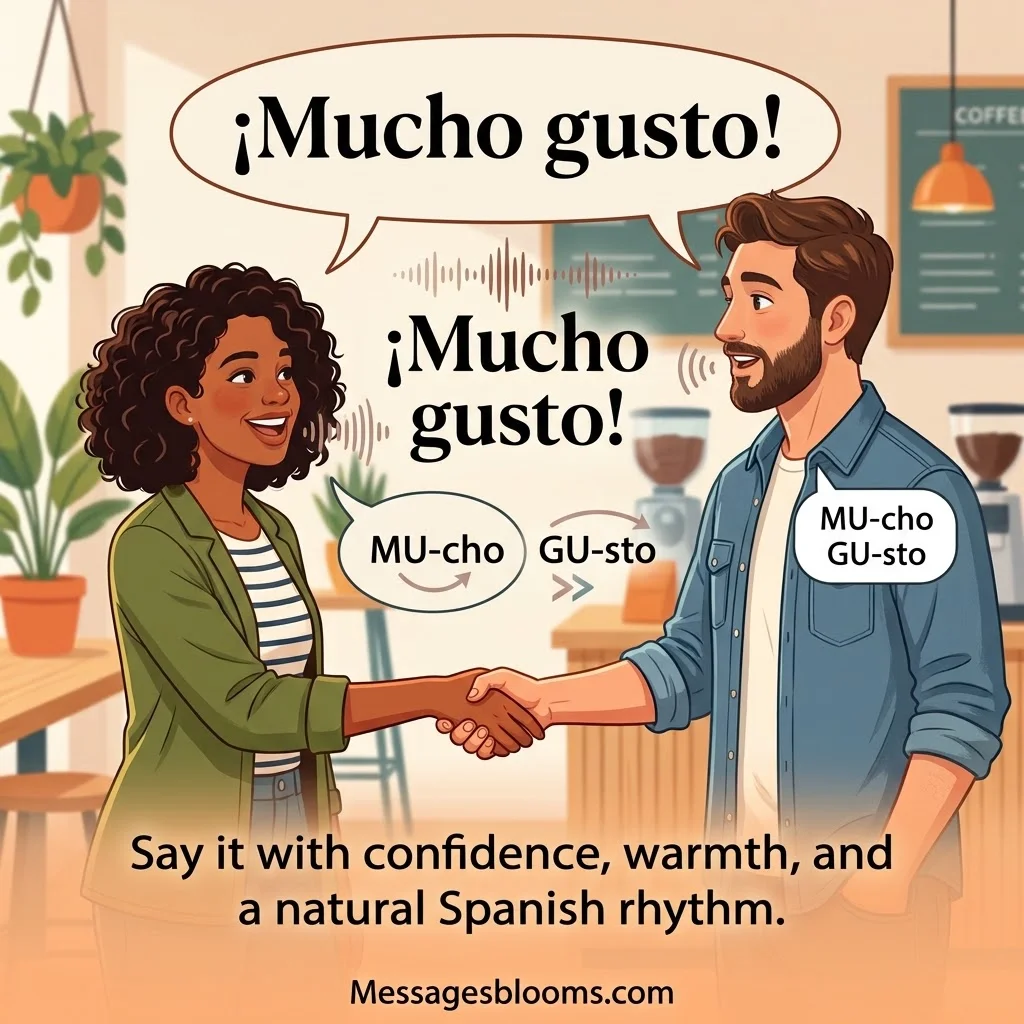
A new coworker shakes your hand and says “mucho gusto.” You smile, but you’re not sure what to say back.
Mucho gusto means “nice to meet you” in Spanish. Its literal meaning is more surprising, and this guide shows you what it is and how to use it.
Table of Contents
What Does Mucho Gusto Meaning in English?
Mucho gusto is a Spanish greeting for first meetings. Here is the meaning, the literal translation, and where the phrase comes from.
What does mucho gusto mean in English? It means “nice to meet you” or “pleased to meet you.”
What is the literal meaning of mucho gusto? It means “much pleasure.”
Mucho means “much,” “a lot,” or “very.”
Gusto means “pleasure,” “liking,” or “taste.”
Here is the surprise. English says “nice to meet you,” which describes the meeting. Spanish shares a feeling instead: “I feel much pleasure.” That is why a word-for-word mucho gusto translation sounds odd in English.
Many learners link gusto to the verb gustar (“to be pleasing”). In this phrase, though, gusto is a noun. It is not a verb form.
The word has old roots. Gusto comes from the Latin gustus, which meant “taste.” Over time, “tasting” turned into “enjoying.” English borrowed it too, as in “with gusto”.
The phrase is also a full sentence. You don’t need to add anything after it.
Setting
What it means
Meeting someone in person
Nice to meet you
Being introduced by a friend
Pleased to meet you
Work or business
It’s a pleasure to meet you
First message in a chat or DM
Nice to connect
Meeting someone’s family
I’m happy to meet you
How to Pronounce Mucho Gusto
Mucho gusto is pronounced MOO-choh GOOS-toh. Both words put the stress on the first syllable.
How do you pronounce mucho gusto? Follow these steps:
Mu sounds like “moo” in “moon.”
Cho sounds like “choh” in “chocolate.”
Gus sounds like “goos,” not like the English word “gust.”
To sounds like “toh,” with a short, clean ending.
English speakers often say “MUCK-oh GUS-toe.” Spanish vowels are short and pure, so keep the “u” round and the final “o” crisp.
Don’t worry about a perfect accent. A warm smile matters more than flawless sounds.
How to Use Mucho Gusto in Real Life
You can use mucho gusto in most first-time introductions. Here is when it fits, when it doesn’t, and how formal it is.
Use it when you:
Meet someone new for the first time.
Are introduced by a friend.
Meet a coworker, client, or neighbor.
Meet a partner’s parents.
Join a new group chat.
Skip it when you:
Greet someone you already know. Say “hola” or “qué gusto verte” instead.
Say goodbye. Say “fue un placer conocerte” (“it was a pleasure to meet you”).
Is mucho gusto formal or informal? It is neutral, so it works in both. You can say it to a CEO or to a friend’s cousin.
To sound formal, say “mucho gusto en conocerlo” (to a man) or “mucho gusto en conocerla” (to a woman). “Es un placer” is very polite.
To sound casual, say “mucho gusto en conocerte” or just “un gusto.”
About 45 million people in the U.S. speak Spanish at home, roughly 14% of the population, according to Census Bureau figures. You are likely to hear this phrase at job interviews, school meetings, clinics, and customer desks.
In a text or DM, it means the same thing. A LinkedIn message might open like this: “Hola, Ana. Mucho gusto. Thanks for connecting.”
Mucho gusto vs. con mucho gusto is a common mix-up:
Mucho gusto means “nice to meet you.”
Con mucho gusto means “with pleasure” or “my pleasure.”
A waiter might answer your “gracias” with “con mucho gusto.” Using the wrong one sounds a little off.
A short example:
Maya: “Hi, I’m Maya.”
Carlos: “Mucho gusto, Maya.”
Maya: “Igualmente.”
While “mucho gusto” helps you understand a common Spanish expression, everyday communication also comes with plenty of modern texting shortcuts. If you’ve come across HBU in a message and wondered what it means, learn more about this popular texting acronym and how to use it naturally.
How to Reply to Mucho Gusto
The easiest answer is “igualmente,” which means “likewise.” Here are more options by tone.
What should you say after mucho gusto?
Tone
Reply
Meaning
Standard
Igualmente
Likewise
Standard
Mucho gusto
Nice to meet you too
Warm
El gusto es mío
The pleasure is mine
Friendly
Mucho gusto también
Nice to meet you too
Professional
Es un placer conocerlo/la
It’s a pleasure to meet you
Chat or DM
Igualmente 😊
Likewise
Don’t speak Spanish? Say “Nice to meet you too” or “Likewise.” People appreciate the effort.
Watch the endings on encantado and encantada. They follow the speaker, not the listener. A man says “encantado.” A woman says “encantada.”
Habits shift by place. In Spain, “encantado/a” is very common, often with two cheek kisses. In Mexico and Central America, “mucho gusto” is everywhere. In South America, “un gusto” is popular, and in Argentina you will often hear “un placer.” In the U.S., a handshake works in most settings.
A simple rule: open with “mucho gusto,” and answer with “igualmente.”
FAQS
What does mucho gusto mean in English?
It means “nice to meet you” or “pleased to meet you.” You say it when you meet someone for the first time. Example: “Hola, soy Ana. Mucho gusto.” (Hi, I’m Ana. Nice to meet you.)
What is the literal meaning of mucho gusto?
The literal meaning is “much pleasure.” Mucho means “much,” and gusto is a noun meaning “pleasure” or “liking.”
What does mucho gusto mean in Spanish?
It is a polite greeting that expresses pleasure at meeting someone. It is used in introductions across the Spanish-speaking world.
How do you pronounce mucho gusto?
Say MOO-choh GOOS-toh. Stress the first syllable of each word and keep the vowels short and clean.
Is mucho gusto formal or informal?
It is neutral, so it fits both. For extra respect, say “mucho gusto en conocerlo/la.” For a relaxed tone, say “un gusto.”
Conclusion
Mucho gusto is short, warm, and easy to use. Say it when you meet someone new, and answer it with “igualmente.” Next time you are introduced, try it with a smile. If you want more everyday Spanish, learn “de nada,” “por favor,” and “hasta luego” next.
Sohail John is a creative SEO content writer who crafts engaging, humorous, and audience-focused digital content. He specializes in writing viral blog posts, catchy headlines, and social media captions that attract readers and improve search engine performance. His writing style combines clarity, creativity, and entertainment to deliver high-quality content that boosts engagement and builds strong online presence for websites and brands.